Discovering Vélez-Málaga: the secrets history forgot
Are you passionate about travelling to places with soul, far from the overcrowded tourist circuits? At Travel Factory Andalucía, we love designing small-group experiences and accompanying you to discover this land from the inside, pausing at those tiny details that completely transform a journey. Today, we want to take you to a corner of the Axarquía that hides more secrets per square metre than you could possibly imagine: Vélez-Málaga.
To unearth the most surprising and unknown passages of this town, we have delved into the informative notebooks of Legajos Sueltos, an exceptional portal edited by the historian Francisco Miguel González López and dedicated to rescuing the region's past through rigorous research. Thanks to this documentary work, today we can share with you a journey through time filled with fascinating characters, ancient engravings, and geopolitical twists that turned Vélez-Málaga into an authentic cultural melting pot.
1. The mysterious monk of Vélez who ended up in the Prussian court
One of the most astonishing secrets of Vélez-Málaga has a first name and a surname: Álvaro Agustín de Liaño (1782-1848). Born in this very town, Liaño’s life reads like an adventure novel. He began his spiritual path by taking his vows as a monk of the Carmel of Santa Teresa and even served as a missionary in Africa.
However, destiny had a radical twist in store: upon his return, he embraced Protestantism and moved to Berlin, where he worked in the royal library of the Prince of Prussia. There, he became an essential cultural bridge, transmitting Spanish and Portuguese literature and culture in the heart of Europe. After a life filled with religious controversies and writings, he ultimately re-embraced the Catholic faith, leaving an indelible mark as a bibliophile and historian.
2. Enrique Sánchez de León: the genius who revolutionised theatre
If you stroll through the streets of Vélez-Málaga, you will be treading the birthplace of one of the great reformers of 19th-century Spanish theatre: Enrique Sánchez de León. Although traditional historiography had relegated him virtually to oblivion until today, this creative native of Vélez took his art and vision from his hometown all the way to the major theatres of Madrid and the Americas. His figure reflects the hidden talent treasured within the historical heritage of our region.
3. Joris Hoefnagel and the town's first official glimpse
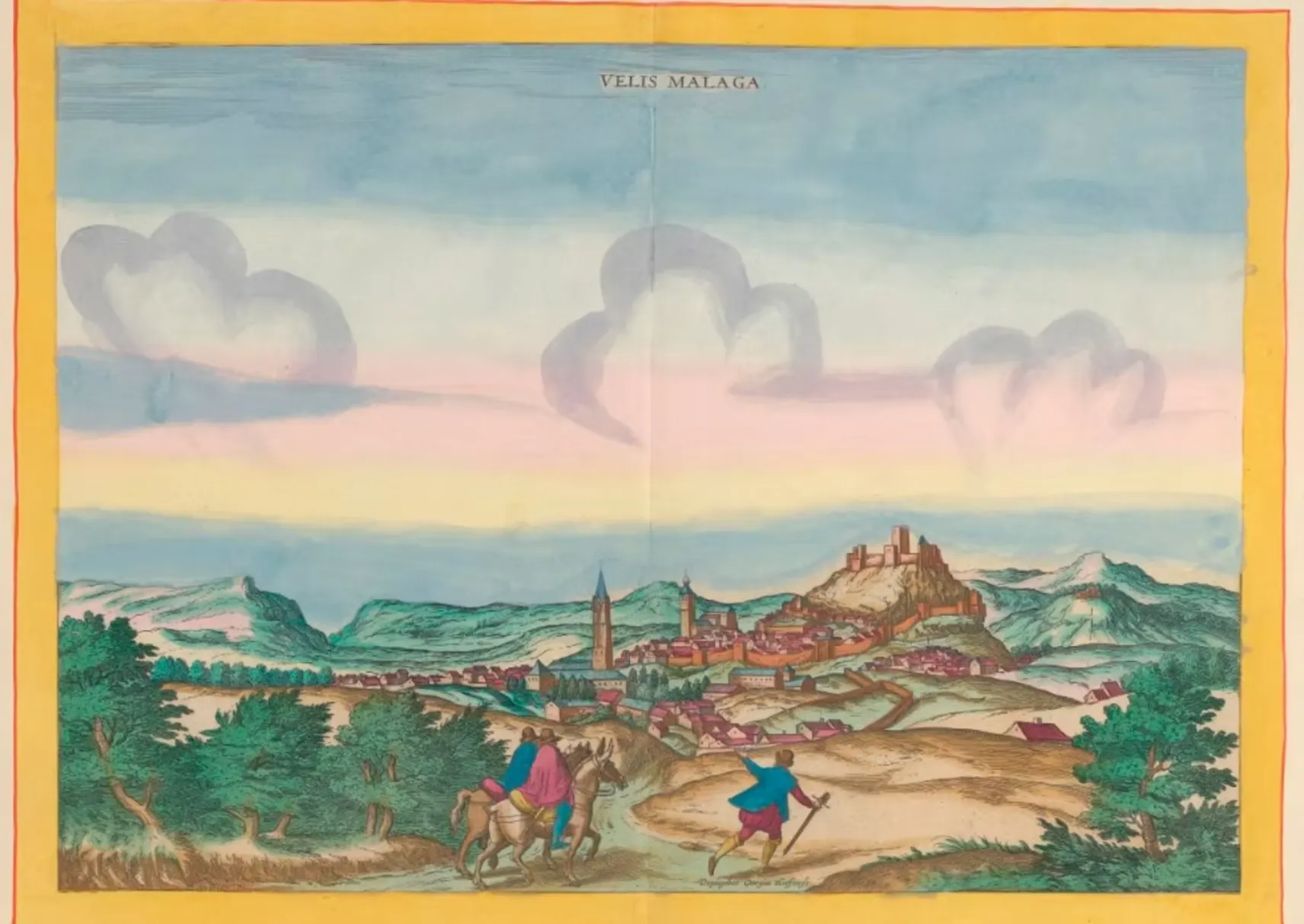
How was Vélez-Málaga viewed by the outside world centuries ago? The secret is revealed to us by the Flemish artist Joris Hoefnagel, creator of the town's first known engraving. His work formed part of the celebrated Civitates Orbis Terrarum, the most important urban atlas of the era. This engraving not only holds inestimable historical value as a visual record but also captures the prominence and majesty of this Andalusian town along the routes of 16th-century travellers.
4. An English Civil War battle... in the waters of Vélez!
The year was 1650 when the coastal waters of Vélez-Málaga suddenly became the stage for an international geopolitical conflict. A seemingly minor episode ended up directly linking the Axarquía with the English Civil War, pitting the interests of British Parliamentarians and Royalists against each other just off the Veleño shoreline. This clash forced the Spanish Monarchy to maintain a delicate diplomatic balancing act to manage the situation within its waters. An extraordinary chapter where the echoes of British politics resonated loudly in the Andalusian Mediterranean.
5. The social pulse of the archives: romani communities and women of the Axarquía
The documentary archives also conceal the social history of the groups that built the region's identity from the ground up, providing a vibrant, everyday social pulse. During the 18th century, Vélez-Málaga and its surrounding villages were home to a deeply rooted Romani (gitano) population. The historical analysis of census records from this period reveals their remarkable integration into the region's guild economy. We now know the real names and trades of individuals who energised the local economy, such as the essential master blacksmiths Juan Madrid (in Canillas de Aceituno) and Francisco Cortés (in Comares), who tended vineyards and tilled the land alongside his forge. We also find agricultural labourers and master basket weavers like Manuel de Heredia (in Canillas de Albaida) and Juan de Arjona (in Alfarnate).
Similarly, current historical research seeks to break traditional historical moulds to give a voice and a name to the women of the Axarquía. These accounts travel through time, starting from the very origins of the region with "Pepita", the most emblematic prehistoric skeleton found in the Nerja Cave, which became a milestone in paleoanthropological research. They also cover women of later centuries whose rural trades sustained society, such as Petronila Lozada, who dedicated herself to the meticulous craft of basket weaving, or Sebastiana Fernández, who carried out the vital community role of midwife. These women sustained daily life, the rural economy, and community care networks, shaping an essential part of the authentic identity that we are so passionate about showing you.
Experience the Axarquía with a different perspective
On your next getaway to Málaga, don't just stay on the surface. Behind every whitewashed façade and every hidden corner of Vélez-Málaga, there is a living piece of history waiting to be discovered.
Explore every single corner with our scheduled tour Vélez-Málaga & Caleta de Vélez, the Footprints of Time: From the Valley to the Sea departing directly from Malaga city centre or, if you prefer, get in touch with us to design a completely personal itinerary and create your own bespoke experience. We will fully adapt to your dates, pace, and historical interests to ensure you enjoy an unforgettable day out in a small group.